JOIN US ON TIKTOK.....@SILVERCLAYSTUDIO

New Hobby? Health & Safety

Before starting any new hobby at home that involves Fire...Butane Gas torch, Gas hob, Kiln / other plus sharp tools.

Please consider the risks involved in any new hobby...

  1. Do a risk assessment
  2. Do you have a safe ventilated room/work area
  3. Do you have a small Fire extinguisher/fire blanket
  4. Eye wash station / Safety glasses
  5. Are you insured / Do you rent property
  6. Store materials/tools locked up and  away from children
  7. Wear suitable clothing/closed footwear
  8. Make sure someone knows what you are doing and can check in with you in case of any emergency


Silverclay Studio

ABOUT THE TUTOR - Pat has over 35 years management experience in making complicated instructions into easy step by step instructions and training for front line staff, virtual teams and product management and development.

Pat has managed many business premises/Post offices and a business centre so is aware of many Risks and H&S faced on premises by staff, customers and students.

Starting Silver Clay

  1. Important - HEALTH & SAFETY.
  2. Fire extinguisher
  3. No uncovered feet
  4. Safety glasses
  5. Dusk mask
  6. Tie back hair
  7. Carefully stored sharp tools
  8. Neat work surface
  9. Rubber block small/large


Silver Clay

  1.  Silver clay
  2.  Syringe
  3.  Silver clay paste

There are now a variety of Silver clays available. Pure 999 silver.

You can use this brand...

  1. Art clay silver
  2. Art clay Silver syringe
  3. Art clay silver paste


Gas Torch

For students I suggest you use a Gas Torch as the safest method to fire silver clay up to the the size of a 50p coin.

Other options are a Gas hob/Kiln

  1. Butane Gas MicroTorch
  2. Fire Brick for firing
  3. Vermiculite Firebrick Fire Board Heat Proof
  4. Charcoal soldering block
  5. Soldering tweezers/ceramic tweezers

TEXTURES

  1. Texture mats
  2. Rubber stamping designs
  3. Wallpaper textures
  4. Nature - ferns, leaves, flowers

TOOLS & Other items

  1. Cookie cutters
  2. Craft knives
  3. Steel/Brass brush
  4. Water brush
  5. Water spray bottle
  6. Badger balm / olive oil
  7. Playing cards
  8. Ball burnisher/ Agate burnisher
  9. Spacer set
  10. Roller - variety Glass, Acrylic
  11. Polishing papers
  12. Sanding pads
  13. Non stick sheets

STOCKISTS  -   Tools Equipment / Silver Clay 

  1. www.hswalsh.com
  2. www.cooksongold.com
  3. www.metalclay.co.uk
  4. www.ebay.co.uk
  5. www.amazon.co.uk
  6. www.hobbycraft.co.uk

Excellent customer service - step by step Silver clay instructions


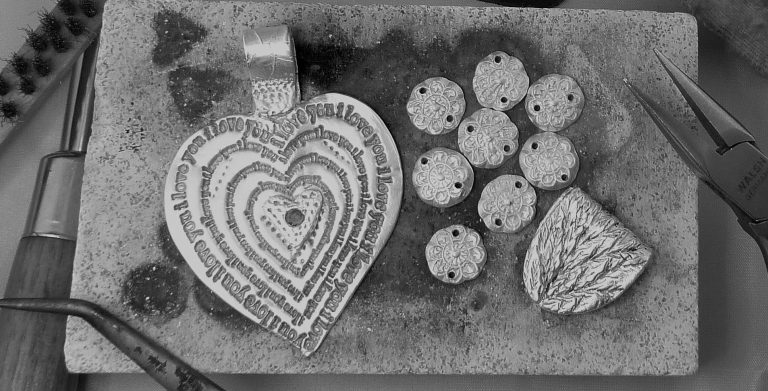
The process of turning clay into silver

1. Components

Silver clay is typically composed of three main ingredients: 

  • Microscopic silver particles: These are often recycled from the electronics and photography industries.
  • An organic binder: This is usually plant-based and acts as the material that holds the tiny metal particles together, allowing them to be worked and sculpted.
  • Water: This gives the clay its pliable, "clay-like" consistency. 

2. Shaping and drying

The clay can be molded by hand or with tools, just like traditional clay. After the desired shape is achieved, the piece must be allowed to dry completely. During this time, the water evaporates. 

3. Firing and sintering


The dried piece is then heated to a high temperature using a jewelry kiln, a gas stove, or a handheld butane torch. 

  • Burning the binder: As the heat is applied, the organic binder burns off completely, often producing a small flame and some smoke.
  • Sintering the metal: Once the binder is gone, the microscopic silver particles fuse together in a process called "sintering." The piece will begin to glow with a peachy-orange color, which must be maintained for a few minutes to ensure the particles bind into a solid metal object. 

4. The finished result

After firing and cooling, what remains is a solid piece of fine silver, typically 99.9% pure. 

  • Pure silver: Since the binder is completely burned away, the final product is a piece of solid silver that can be legally hallmarked as "fine silver" (.999).
  • Shrinkage: Because the water and binder make up a portion of the original clay's volume, the finished silver piece will be smaller than the unfired clay.
  • Finishing: The fired piece will have a white, frosty appearance. It is then polished and burnished to achieve a smooth, shiny finish, indistinguishable from silver made using traditional methods.


PMC3 Silver clay lump /Paste/syringe (discontinued but still available at some stockist)

Art Clay Silver lump /Paste/syringe

Textures / Texture mats

Sterling Silver wire / Jumprings / Earwires

Polishing papers/tools/sandpapers

Badger Balm

3M Polishing papers

Agate Burnisher

Anti tarnish silver polishing cloth

Brass/Steel wire brush

Self locking tweezers

Safety glasses

Butane gas micro torch

Acrylic roller/Acrylic tool kit

Fire brick/Firing sheet

Cookie cutters

Soldering block/board/sheet

Natural charcoal block


©Copyright. All rights reserved.

We need your consent to load the translations

We use a third-party service to translate the website content that may collect data about your activity. Please review the details in the privacy policy and accept the service to view the translations.